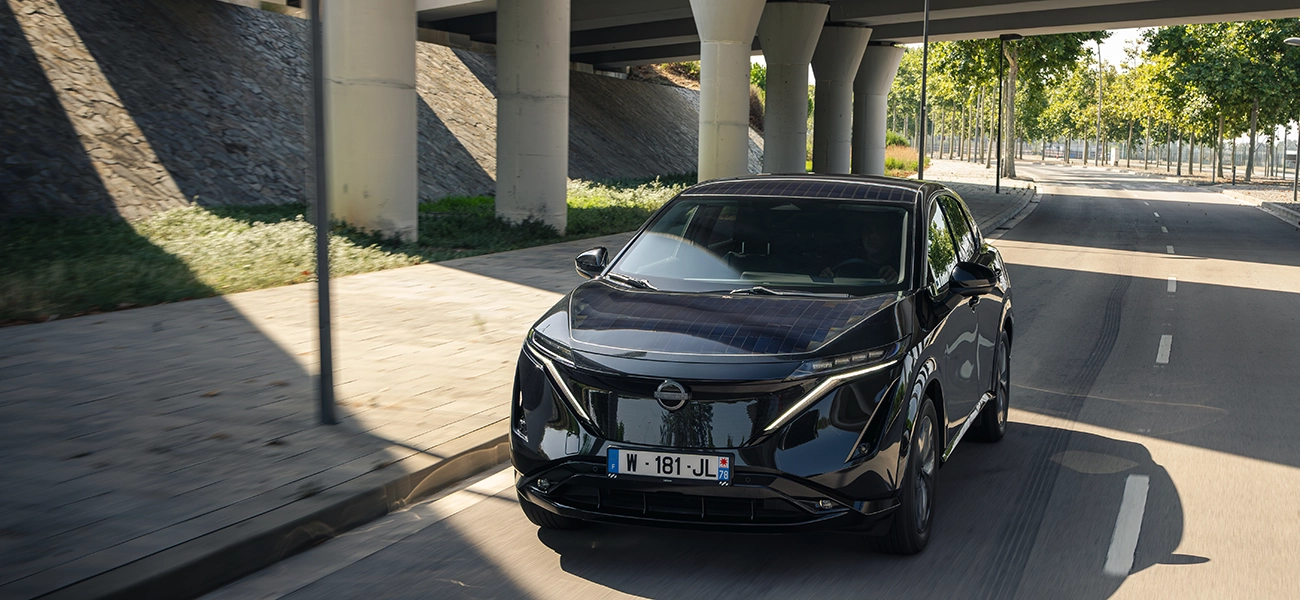
Driving on Sunshine: The People Who Turned a Daring Idea Into a Solar-Powered Concept
What if your car could charge just by driving under the sun?
For two Nissan engineers, Jorge Paganetto and Jagoba Estébanez, from our Advanced Product Planning team in Dubai and our Powertrain Planning team in Barcelona, that question wasn't science fiction.
It was the beginning of a project that pushed the boundaries of what an electric future could be, while supporting Nissan's commitment to cleaner mobility technology.
They were bold enough to imagine the concept, and determined enough to build it.
Today, their answer shines bright: a solar-powered Ariya concept equipped with 3.8m² of custom solar panels across its hood (polymer based), roof and tailgate (glass based).
The vehicle's integrated solar panels uses high efficiency photovoltaic cells that convert sunlight directly into DC electric power.
This energy is managed through an optimised power controller, increasing overall energy availability and reducing dependency on external charging.
The roof does the heavy lifting, capturing solar energy across its large, sun-exposed surface.
The concept showcases a leap in charging efficiency, generating in a city like Barcelona an average of 17.6km of solar driving range per day, and cutting charging frequency by between 35–65%, depending on user profile.
Real-world testing also showed the concept could generate 0.5 kWh of solar energy during a 2‑hour, 80km trip, delivering up to 3km of range at no extra cost or charging time.
In clear, sunny conditions, the solar panels can generate enough clean energy to power up to 23km in additional range.
Over the course of a year, this could mean an average additional range per day of 10.2km in London, 18.9km in New Delhi and 21.2km in Dubai.
The Idea That Sparked a Movement
The journey began with one simple idea: the sun - the most abundant renewable energy source on earth – being harnessed to support EV mobility.
That idea ignited exploration and collaboration with Lightyear, a Dutch-based company specialising in solar charging technology for EV's. They provided the panels, as the concept slowly edged closer to reality.
Bonna Newman, Lightyear CEO:"It's incredible to look back at our initial conversations and see how far we've come.
What started as an idea has become an innovative reality, thanks to the dedication and hard work of those involved.
Working with Nissan has been genuinely exciting, and it's especially rewarding to see Lightyear technology applied in a way that demonstrates high aesthetics, high performance, high impact."
Innovation, Driven by People
Initial test drives conducted over the summer in a 1,550km trip from Lightyear's offices in the Netherlands to Barcelona, Spain showed that the concept was capable of:
- Reducing annual charge visits from 23 to 8, for commuters travelling approximately 6,000km per year;
- Enabling drivers to experience – on average – 50% more time between charges, for commuters travelling roughly 12,000km per year.
Such a result represents potential for regions with limited charging infrastructure, giving drivers more independence, autonomy and confidence.
"Exploring innovative technologies is a must on our journey to electrification; one that Nissan is committed to", commented Jagoba Estébanez from Powertrain Planning in Barcelona. "Working with like-minded colleagues on this project, exploring how we can work towards a cleaner future makes me proud to work for a company that values combining innovation with a commitment to sustainability".
A Step Toward Nissan's Carbon-Neutral Future
This concept is a statement and sign of what's possible when creativity meets commitment. "As the world changes and technology develops, it is important to see forms of energy such as solar as a potential paradigm shift, bringing a new layer of convenience and innovation to the driving journey," said Jorge Paganetto, from Product Planning in Dubai. "That's why this concept pushes the boundaries in terms of what's possible in this changing world of electric mobility, demonstrating the possibility of building even more efficient EV's."
It reflects Nissan's long-term ambition for a cleaner planet and its goal of carbon neutrality by 2050. Want to hear more about these goals and how Nissan is tracking towards them?
Click here: https://www.nissan-global.com/EN/SUSTAINABILITY/.