Accelerating Toward a Sustainable Future: NTCE’s Role in Advancing Autonomous Mobility
At Nissan Technical Centre Europe (NTCE), a quiet revolution is underway. Behind the gates of this facility, engineers and researchers have been building the next chapter in autonomous mobility - one rooted not just in pioneering technology, but in sustainability, inclusivity, and real-world relevance.
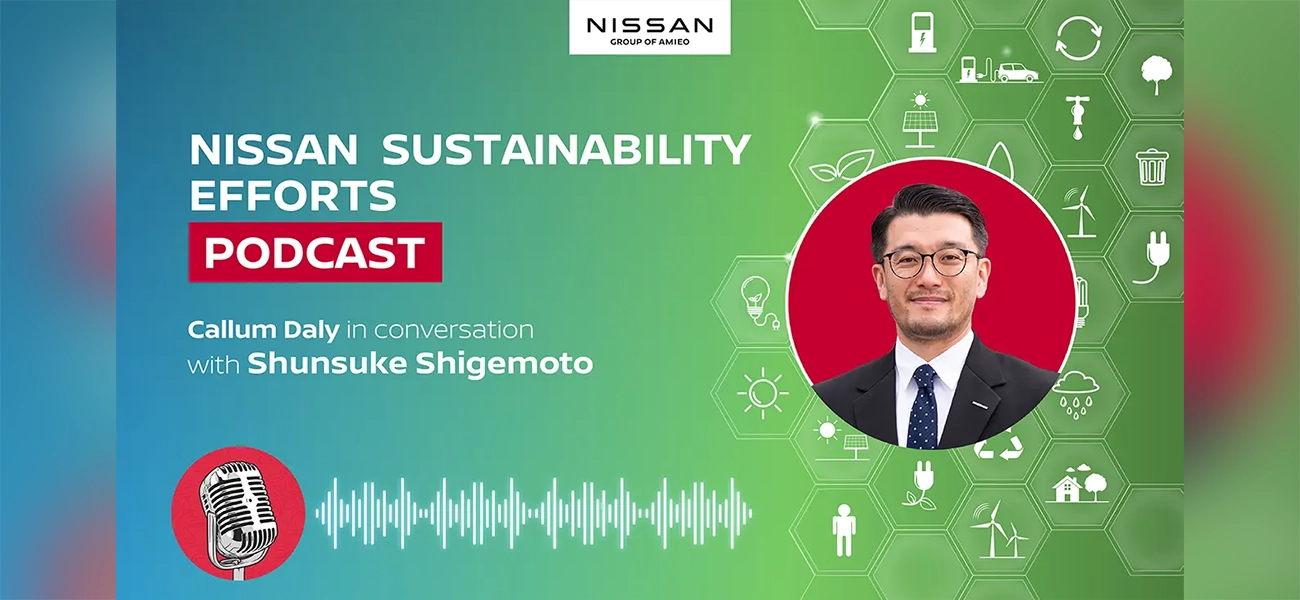
Hear from Shunsuke Shigemoto, Vice President of ePowertrain Technology, Research and Advanced Engineering,
as he shares how Nissan's latest research is helping shape the future of autonomous mobility.
Pioneering the Path to Autonomy
Over the past eight years, NTCE has served as the hub for three major autonomous vehicle (AV) research programmes in collaboration with key industry partners: HumanDrive, ServCity, and most recently, evolvAD. Together these initiatives have advanced Nissan's capabilities in self-driving technology by tackling real-world challenges across diverse driving environments.
- HumanDrive (2017 - 2020): This project explored how AVs could navigate UK roads safely and confidently – from motorways to rural lanes. It culminated in the Grand Drive: a 230-mile journey from Cranfield to Sunderland in a Nissan LEAF, operating autonomously for 98% of the route. In parallel, the team tested machine learning-based driving behaviours on private tracks, refining systems to create more natural, human-like performance and a smoother passenger experience.
- ServCity (2020 – 2023): ServCity developed Connected and Autonomous Vehicles (CAVs) that communicate with city infrastructure to improve situational awareness in dense urban environments. Using pre-existing CCTV and sensor networks, the CAVs navigated London's complex traffic scenarios with precision, from bus lanes and cyclists to pedestrians and roundabouts.
- evolvAD (2023–2025): The final phase, evolvAD, was the most rigorous test of Autonomous Drive (AD) technology in the UK – further advancing Nissan's pursuit of truly human-like autonomous driving. CAVs were trialled in some of the most challenging environments – from narrow residential streets to winding, unmarked country lanes. While existing infrastructure like residential CCTV wasn't essential, it enhanced situational awareness and decision-making, offering a unique test study on how vehicle-to-infrastructure (V2I) can boost CAV performance.
Together, these projects have covered over 16,000 autonomous miles with zero road accidents – steadily building the real-world experience that has refined Nissan's logic-based software to deliver safe, explainable driving decisions.
"It feels like a human is driving, not a robot," said Shigemoto, reflecting on the smoothness and realism of the driving experience.
For an overview of evolvAD and its role in our wider AD roadmap, click here.
Technology That Serves Society
Shigemoto highlights that autonomous driving is not just a form of safety tech, but a tool that can deliver transport equity.
In locations with limited public transport such as rural areas or regions with ageing populations, AVs can help sustain mobility and independence. The team at NTCE is focused on real-world applications that bridge access gaps and improve everyday lives.
"Sustainability isn't just about reducing emissions," says Shigemoto. "It's about sustaining mobility for individuals."
The Road Ahead: From Testing to Public Trust
Across NTCE, teams from software engineers to safety drivers have contributed to a shared mission: building safe, human-like AD systems that support Nissan's wider sustainability strategy.
While the technology continues to evolve, one of the biggest remaining challenges is public acceptance. Shigemoto believes exposure and experience are key.
"People need to experience autonomous cars firsthand to trust them," he says. "Seeing how the vehicle gracefully handles a tight residential lane, or a bustling pedestrian crossing can transform scepticism into excitement."
When it comes to rolling out this technology, Nissan is preparing to launch customer-focused autonomous mobility services in Japan, starting from fiscal year 2027. These services will offer convenient, on-demand transportation – benefitting communities facing driver shortages and limited public transport options in rural areas. Pilot programmes are already underway in Yokohama and Fukushima. Read more about Nissan's autonomous mobility service roadmap here.
As Nissan looks ahead to the next generation of mobility, NTCE's work is a powerful example of how technology, sustainability, and social responsibility must work hand in hand.
Listen to the full podcast episode above and explore our broader goals at nissanamieosustainability.com